Question-Based Selling: The Complete Guide With Examples
The short answer
Question-based selling is a way of selling where you move the conversation with questions instead of statements. You ask before you tell. The buyer's own answers make the case, and your product shows up only as the answer to a problem they've already described in their own words.
It works for one simple reason. A statement puts pressure on you. A question hands that pressure across the table.
The phrase is closely tied to Thomas Freese's book Secrets of Question Based Selling. This guide is the way I teach it in ConvoControl. It's built around the six reasons people say no, and around one idea: knowing the right question doesn't help you if you can't ask it under pressure.
Why questions beat statements
Think about what a statement does in a sales conversation. You said it, so now you have to be right about it, back it up and hope it landed. The buyer just sits there and scores you. They have the easiest seat in the room.
A question does the opposite. Now the buyer has to think and answer, and they're in the conversation instead of watching it.
Three things happen when a seller switches from statements to questions:
- The buyer stops scoring and starts talking. You can hear it. Their answers get longer, and they start saying "honestly."
- You find the real objection. Buyers almost never say the real reason out loud. A good question surfaces it.
- The buyer convinces themselves. Nothing you say about ROI will ever be as persuasive as a number that came out of their own mouth.
Pitching is pressure. Asking is pull. When you talk at someone, they lean back. When you ask them something real, they lean in.
The person who controls the conversation controls the outcome. Whoever asks, steers.
Question-based selling, stage by stage
The questions change at every stage of the deal. The principle doesn't: ask before you tell.
The open: three questions before you pitch
The first thirty seconds decide whether this is a conversation worth having. Open with these three, in this order:
| Question | What it does |
|---|---|
| "Before I tell you anything about us, can I ask you a couple of questions first, so I don't waste your time?" | Permission. Tells them you're not about to pitch, and earns the right to ask. |
| "What would make this call genuinely worth your while?" | Agenda. Hands them the wheel, and tells you out loud how to win the call. |
| "What made you take this call?" | Priority. Tells you what the conversation is really about for them. |
Discovery: the three-question spine
Every feature you own is a frozen answer to a question you haven't asked yet. Ask the question first:
- "Walk me through how you're handling this today. What does that actually look like?"
- "What is that costing you? Time, money, headaches. Pick one and put a number on it."
- "If nothing changes for a year, where does that leave you?"
The third one matters most. You're not creating urgency, which never works. You're asking them to look at the cost of doing nothing, which is your real competitor in most deals.
Then follow the Feature Flip rule: never name a feature until you've asked the question it answers. Say their exact words back, then name the feature. "You said stale numbers and half a day a week. This is the part built for that."
If they booked a demo and want to see the product, ask for the trade: "I've got the demo ready and I'll show you everything. Can I ask you three questions first, so I only show you the parts that matter?" Nobody says no to a shorter meeting.
Finding the real decision maker
By minute five, ask: "Who else weighs in on a decision like this?"
If the person on the call can't say yes, everything after this is practice. Find out early, while you can still get the real buyer into the room.
Objections: five seconds, then one question
When a buyer pushes back, most sellers defend. In question-based selling, you diagnose. First, five full seconds of silence. Then one question aimed at what's really behind the objection.
There are only six reasons people say no. Each one has a question that brings it out:
| Reason | What it sounds like | The question |
|---|---|---|
| Money | "It's too expensive." | "If the price were exactly right, would you move forward today?" |
| Trust | "I'm not sure it's right for us." | "Put price aside for a second. What would need to be true for this to feel like a smart decision?" |
| Timing | "Now's not a good time." | "Is it the price, or is it the timing?" |
| Ego | "Actually, that's not how it works." | "What would have to be true for this to work here?" |
| Fear of Change | "Let me think about it." | "If you had to lean one way right now, which way would you lean? And what's pulling you there?" |
| Third-Party Approval | "Let me run it by the team." | "Who else needs to weigh in before this can move?" |
Money is the reason buyers claim the most and mean the least. "Too expensive" is usually what uncertainty sounds like.
The buyer who knows everything
When the buyer is an expert, never correct them. Hand them the expert seat instead:
- "You clearly know this space. What has everyone who pitched you gotten wrong?"
- "What would something have to prove before you took it seriously?"
When they say something flat wrong, trade the correction for a question: "Where did you see that happen? Walk me through it." They usually get to the right answer themselves, and that's the only way it ever sticks.
"Let me think about it"
Never answer a stall with "take your time." Use three moves instead:
- The Invite: "What specifically do you want to think through? Let's think it through together while I'm right here."
- The Lean: "If you had to lean one way right now, which way would you lean? And what's pulling you there?"
- The Decision Booker: "What will you know next Thursday that you don't know today?"
The close: one question, then silence
When the buyer starts asking when, who and how, the decision is made. Stop presenting and ask:
"Sounds like you're ready. Should we make it official?"
Then say nothing. The next voice in the room is theirs. Once they say yes, you get one more question: "What do you need from me to get started?" After that, logistics only.
Silence is not awkward. Silence is respect for a decision being made in front of you.
The follow-up: one new thing, one question
A follow-up gets two lines. Line one carries something new: an insight, a better answer to something they asked, or something that changed in their world. Line two asks exactly one question, aimed at the reason the deal is stuck.
When a deal goes quiet for weeks: "Should I close the file on this, or is it still live?" It gets answered almost every time.
The rules that make it work
- One question at a time. Three questions in a row is a survey, and people don't answer surveys.
- Then be quiet. A question followed by your own answer is just a statement with extra steps.
- Use their words. Repeat their exact phrase back before you name a feature. It proves you listened, and that's most of what Trust is.
- Ask honest questions. These are not tricks. You ask them because you actually want the answers.
- Don't interrogate. In a controlled conversation the buyer talks more than you do, and they leave feeling it was the best sales call they've had in months.
Common mistakes
- Asking permission, then pitching anyway. "Great, so let me tell you a little about us." Now you're a pitch and a liar.
- Reading the question off a card. Everyone can hear a script. Rep the questions until they sound like you.
- Leading questions. "Wouldn't you agree that saving time matters?" isn't a question. It's a statement dressed up as one, and buyers can tell.
- Filling the silence. Whatever the buyer says in that pause is the real objection. Fill it and you bury the objection where you can't reach it.
- Talking past the yes. Nothing you say after the yes can make them buy more. It can only make them buy later.
How to train it
Here's where most question-based selling falls apart. People read the questions, nod, and then pitch on their next call anyway, because under pressure you fall back on how you've trained. Knowing the concepts isn't enough. You have to train them until they're automatic.
Three drills to start with:
- The flip. Take any statement you say on calls ("Our platform has real-time reporting") and turn it into a question in five seconds ("How long does it take you to find out something went wrong?"). Do ten a day.
- The silence rep. Once a day, ask a closing question out loud and hold thirty full seconds of silence. Time it. You're raising your tolerance, because on a live call your tolerance is the only thing that saves you.
- The open, every call. On your very next call, run permission, agenda, priority. Then do it on the one after that.
Most people read. Few people rep. Which one are you this week?
One of my readers, Jordan Price, wrote that he went from "a consistent 19 percent closing rate" to "high 20s to low 40s some months." His words. His reps.
Questions people ask about question-based selling
What is question-based selling?
A sales method where the seller moves the conversation with questions instead of statements. The buyer's answers do the persuading, and the product comes up only as the answer to a problem the buyer has already described.
Is question-based selling manipulative?
Not when the questions are honest. Leading questions that corner the buyer are manipulative, and buyers feel it. Honest questions do the opposite: they find out whether you can actually help, and sometimes the honest answer is that you can't.
How is it different from SPIN Selling?
SPIN Selling, from Neil Rackham, sorts discovery questions into four types: Situation, Problem, Implication and Need-payoff. Question-based selling as I teach it uses questions at every stage, not just discovery: the open, objections, the close and the follow-up. It also ties each objection to one of six reasons people say no.
Does it work for demos?
Yes. Ask three questions before the demo, then show only the parts that answer what they told you. Your demo gets shorter. In my experience the close rate goes the other way.
How many questions should I ask on a sales call?
There's no number. The test is who talks more. If you're talking more than the buyer, you're not asking enough.
Can a whole sales team learn it?
Yes, but not from a book alone. Teams learn it by drilling it every week, under pressure, until it holds up on live calls.
Train it with me
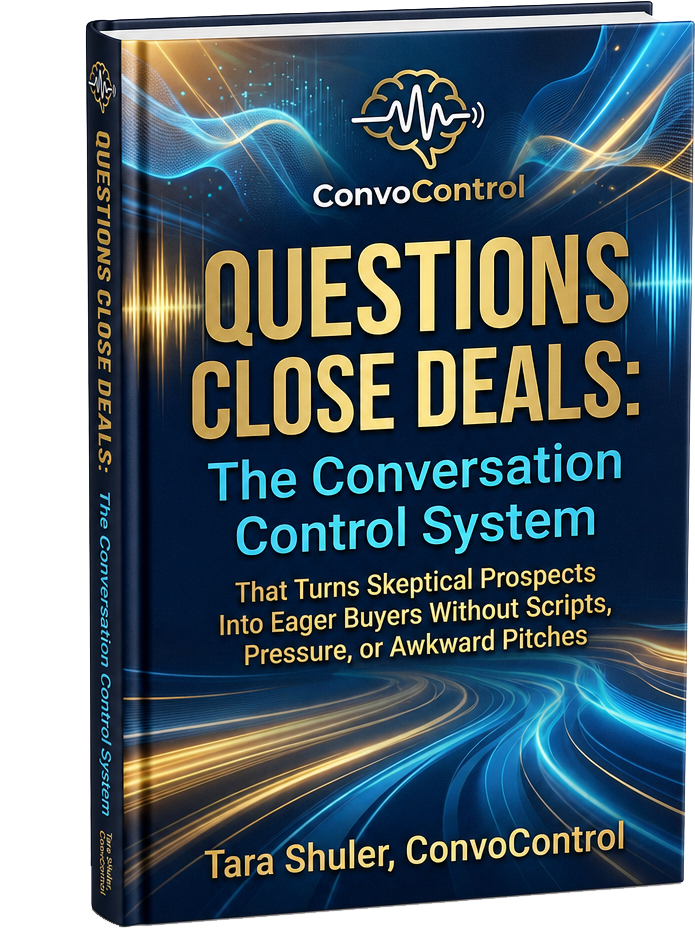
The whole system is in my book Questions Close Deals. If you lead a team, start with how to get your sales team to close more deals.
If you want to train it live, ConvoDojo is where you get the reps. On-site sales team training brings it to your whole team. 1:1 coaching for sales managers trains you until you can't get it wrong.
Not sure where your conversations leak? Take the free Conversation Control Assessment. It's fifteen questions and about four minutes.
So what's the one statement you'll turn into a question on your next call?


